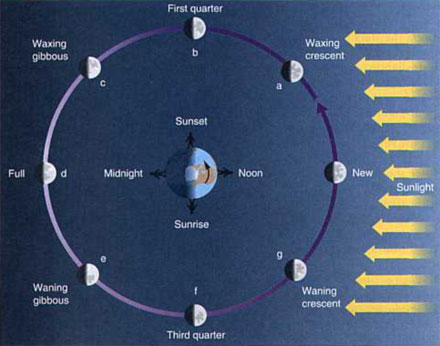
The Moon is the only natural satellite of our planet. It orbits the Earth once per month counterclockwise when viewed above the Earth's North Pole, in the same sense as the Earth's rotation and orbit around the Sun.
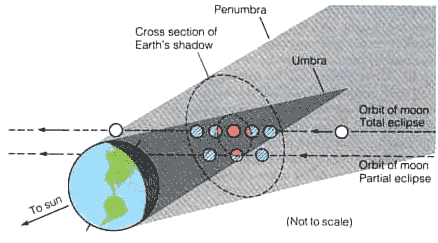
The orbit of the Earth around the Sun and the orbit of the Moon around the Earth are in different planes and so, we can appreciate the different phases of the moon. If they were in the same plane we could not see the full Moon at night (it is what happens in a lunar eclipse) and it would be a solar eclipse every month.
This image shows us the different phases of the moon but doesn't show the actual orbit of the Moon. As you can see, the Sunlight could not reach the Full Moon if they were in the same plane.
 
 
  This image allow us understand better how this really works. It also shows us why there are usually two solar and lunar eclipses per year.
 
 
  Lunar Eclipses  
  A Lunar Eclipse takes place when the Earth is lined up directly between the Sun and the Full Moon. When this happens, the Moon phases through the shadow Earth casts into space for up to 1 hour and 40 minutes and you can see this shadow slowly creeping across the face of the Moon. But, unlike the New Moon, where you cannot see the Moon in the sky at night, during a lunar eclipse the Moon is still visible and shines with a faint red colour. This is due to the scattering of light around the edge of the Earth through its atmosphere.  
 
 
  There are three types of lunar eclipses:

- A total lunar eclipse means that no light from the Sun reaches the Moon.
- A partial lunar eclipse means that part of the Moon has no light reaching it.
- A penumbral lunar eclipse means that some Sunlight is still hitting all parts of the Moon.

In a total lunar eclipse we see all three types of eclipses.


  Moon Map