CSG250: Wireless Networks
Spring 2005
Programming Assignment 2: Network throughput and Medium Access Control
Due: Wednesday, March 09 2005
1.
Network throughput
The goal of this problem is to study the medium access control approach
and its effect on the network throughput. The network has a star
topology as illustrated in the following figure. There are 5 CBR
sessions going on simultaneously. Nodes 1 to 5 all send packets to Node
0.
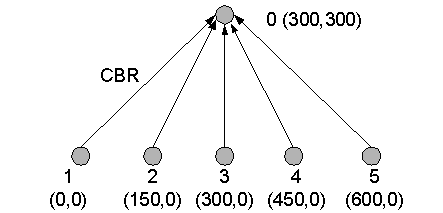
Simulation time: 30S
Radio Tx Power: 25 dBm
Packet Size: 512B
As the transmission rate keeps increasing, the congestion at the receiver gets worse, and also the contention at the senders gets tough.
(a) Explain how IEEE 802.11 resolves or alleviates the problem.
(b) Plot the aggregate throughput of the network as a function of
traffic rate. Is there an equilibrium point for the aggregate
throughput?
2.
Network scalability
In this exercise, we study analyze the capacity of ad hoc networks. One
can define capacity in different ways -- the maximum data rate that can
be achieved overall or the maximum data rate per source, assuming
random destinations, or the maximum data rate per source that can be
achieved by any traffic pattern, etc. We are interested in determining
how the capacity changes as more nodes are put added to the network.
This simulation will help you to understand space reuse, which
determines how well the network scales as we expand the network. You
may find what are the factors, which factors impact network
scalability, and a theoretical analysis in Capacity of
Wireless Networks, Mobicom 2001.
Set up a chain network with N nodes. The distance between two neighboring nodes is 100 meters. Node 0 is the source and Node N is the destination. The packets travel along the chain of intermediate nodes towards the destination (a multihop session).

(a) Increasing N from 1 to 8.
Packet length 1500 B.
Tx Power 1dBm
Traffic rate: Adjust your traffic rate to find the maximum throughput for each N.
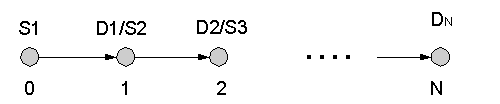
Change the traffic pattern to N single hop sessions. Let ith node be the CBR Client and (i+1)th node be the CBR server as illustrated in the following figure.
(b) Increasing N from 1 to 8.
Packet length 1500 B.
Tx Power 1dBm/10dBm
Traffic rate: Adjust your traffic rate to find the maximum throughput for each N.
Plot your results in one graph and give a brief analysis of the figures.
3. Hidden Terminal and Exposed Terminal problem.
Set up two scenarios to illustrate the hidden terminal and exposed
terminal problem.
(a) Submit your nodes.in, app.conf, config.in.
(b) Explain your settings of transmission power, network topology and traffic pattern and how they create the two problems. Also explain your simulation results, why they imply the existence of the two problems.
The
common settings for these three questions are:
No mobility
Static Routing
Propagation Model: Two-Ray
Radio Rx Type: SNR
RADIO-RX-SENSITIVITY -91.0
RADIO-RX-THRESHOLD -81.0
Applications CBR